
Crypto Recovery Scams: How Victims Can Avoid Being Defrauded Twice
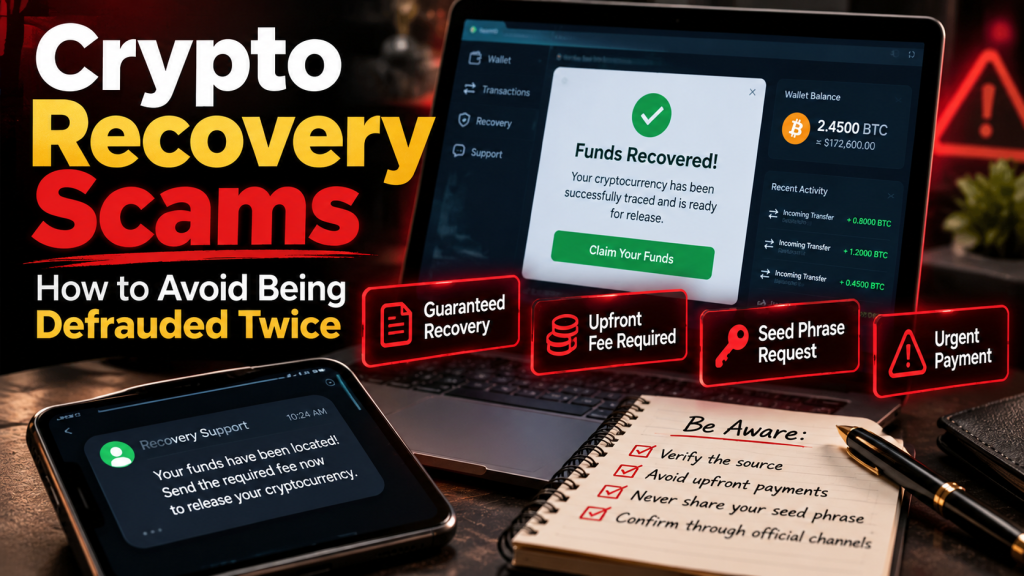
People who have already lost money to cryptocurrency fraud can face another danger almost immediately: crypto recovery scams.
These schemes target people who are actively searching for help. The approach may come through an unsolicited email, social-media message, telephone call, online advertisement, or someone claiming to be an investigator, lawyer, recovery specialist, government representative, or blockchain expert.
The message is usually reassuring: your cryptocurrency has supposedly been located, frozen, traced, or recovered.
Then comes the catch. You must send more money before anything can be returned.
Understanding how these schemes operate can help victims avoid turning one financial loss into two.
Why Previous Fraud Victims Are Targeted Again
Someone who has recently lost cryptocurrency is an attractive target because the fraudster already knows what that person wants: recovery.
In some cases, the new contact may appear to know details about the original incident. That can make the approach seem credible.
But knowledge of a previous loss does not prove that someone has recovered the assets. Information can be obtained from previous communications, online complaints, shared databases, compromised records, or even the people involved in the original scheme.
Treat unexpected recovery offers as claims requiring verification—not proof that your assets have been found.
Crypto Recovery Scams Often Begin With Certainty
One of the clearest warning signs is certainty before meaningful investigation has occurred.
Be cautious when someone says:
- “Your funds have already been recovered.”
- “We located your wallet and can release it today.”
- “Your cryptocurrency is frozen on the blockchain.”
- “Recovery is guaranteed.”
- “Pay this fee and your funds will be released immediately.”
Legitimate investigations depend on evidence. Before anyone can responsibly assess a case, they generally need basic information about the transactions, addresses, platforms, and circumstances involved.
A confident recovery promise made before reviewing those facts deserves scrutiny.
The Upfront Payment Trap
A common tactic is to demand another payment before supposedly recovered cryptocurrency can be released.
The payment may be described as a tax, gas fee, validation charge, withdrawal fee, insurance payment, compliance deposit, blockchain activation fee, or anti-money-laundering charge.
The terminology can sound technical or official.
What matters is the pattern.
The victim is told that money is waiting, but another payment must be made first. After that payment, a new obstacle may suddenly appear and another fee may be demanded.
This cycle can continue until the victim stops paying.
A Wallet Balance Is Not Proof of Recovery
Fraudsters may send screenshots, dashboards, transaction images, certificates, or documents that appear to show recovered funds.
These materials should not be accepted at face value.
A number displayed on a website does not prove that cryptocurrency exists or that the person showing it controls the assets.
Likewise, identifying a wallet containing cryptocurrency does not establish ownership of that wallet or the ability to transfer its contents.
Blockchain tracing can help investigators follow transactions, but tracing an address is fundamentally different from gaining control over it.
Never Share Your Seed Phrase or Private Key
No legitimate recovery assessment requires your wallet seed phrase or private key.
These credentials can provide control over cryptocurrency held in a self-custodied wallet.
Anyone who obtains them may be able to transfer the assets without your permission.
Be particularly cautious of websites that ask you to “connect,” “synchronize,” “validate,” or “restore” a wallet by entering a recovery phrase.
If someone claims they need your seed phrase to investigate a transaction, stop.
Transaction hashes and public wallet addresses can be examined without receiving the credentials that control your wallet.
Impersonation Can Make the Scheme Look Convincing
Some recovery schemes rely on impersonation.
A fraudster may claim to represent a government agency, law firm, cryptocurrency exchange, cybersecurity company, regulator, or financial institution.
Logos and official-looking documents are easy to copy.
Instead of using telephone numbers, email addresses, or links supplied by the person contacting you, independently locate the organisation’s official contact information and verify the claim through that channel.
Do not assume an email address, caller ID, badge number, case number, or professional-looking document is authentic simply because it appears convincing.
Questions to Ask Before Paying Anyone
Before entering a recovery arrangement, slow the process down.
Ask:
What evidence has actually been reviewed?
What specifically has been traced or identified?
What service is being provided?
Why is a payment required?
Is the organisation independently verifiable?
Are they promising an outcome that cannot reasonably be guaranteed?
Have they asked for wallet credentials or additional cryptocurrency?
A legitimate assessment should be able to distinguish between what has been verified, what remains uncertain, and what may realistically happen next.
Pressure and certainty are poor substitutes for evidence.
If You Suspect a Recovery Scam
Stop sending additional payments while you assess the situation.
Preserve the communications, payment instructions, wallet addresses, transaction hashes, website addresses, invoices, and any documents you received.
Do not delete the conversation simply because you have concluded that it may be fraudulent. Those records may contain information useful for understanding what occurred.
If you shared account credentials, passwords, or wallet information, take appropriate steps to secure affected accounts and wallets.
Where appropriate, suspected fraud can also be reported to relevant financial institutions, cryptocurrency services, or law-enforcement authorities.
Report Suspected Recovery Fraud
If you believe you have encountered a fraudulent recovery service, preserve the communications, payment records, wallet addresses, transaction details, and website information connected to the incident. In the United States, suspected internet-enabled financial fraud can also be reported to the FBI’s Internet Crime Complaint Center (IC3). Reporting does not guarantee that funds will be recovered, but it creates an official record that may assist investigators in identifying related accounts, transactions, or schemes.
Recovery Should Begin With Evidence, Not Promises
There is an important difference between investigating a cryptocurrency loss and guaranteeing that the assets will be returned.
Blockchain records may help establish where cryptocurrency moved. Exchange records may help document transfers. Communications may explain how the victim was instructed to send funds.
Those facts can support an assessment of what options may exist.
They do not justify an automatic promise of recovery.
At TopMatters, the starting point is evidence: what happened, what can be verified, where the assets appear to have moved, and what realistic next steps may be available.
For victims of cryptocurrency fraud, caution after the first loss is especially important. The promise of getting everything back can be powerful—but it should never replace careful verification.