
Behind the Trading Website: How to Verify Who You’re Really Investing With
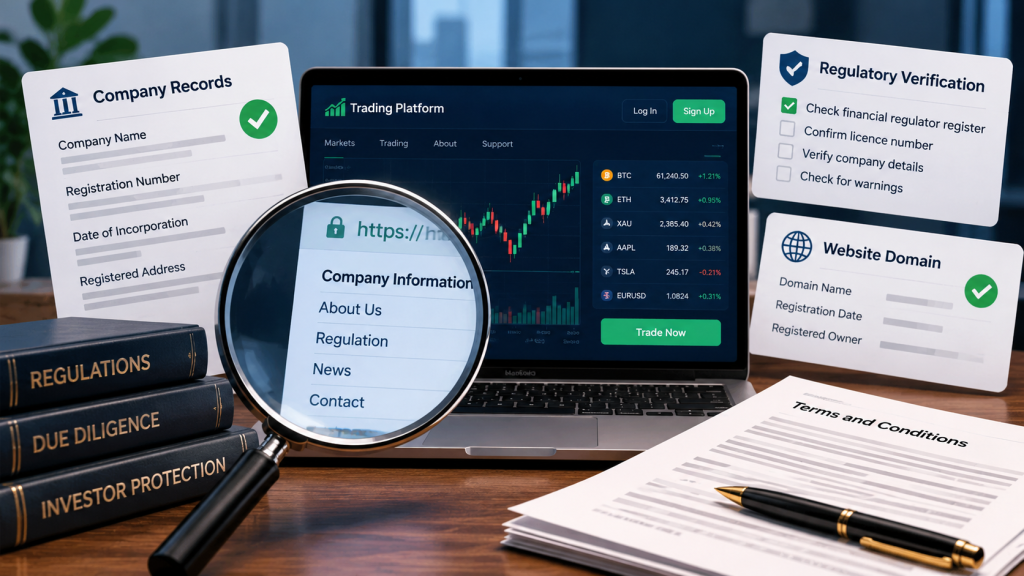
Modern investment websites can look remarkably convincing. Professional dashboards, live market prices, international telephone numbers and photographs of corporate offices can create the impression that a substantial financial company is operating behind the screen. Yet one of the most important checks an investor can perform has little to do with the appearance of the website: identifying the legal entity actually responsible for it. Understanding investment platform ownership can reveal inconsistencies that might otherwise remain hidden until money has already been transferred. Investors who have already encountered problems with a platform can also Submit Your Case to TopMatters for an initial assessment.
Start With the Legal Company Name, Not the Brand
A trading platform’s brand name and the company operating it are not necessarily the same.
A website might trade under a short commercial name while being operated by a limited company with an entirely different legal name. That arrangement is not inherently suspicious. Many legitimate businesses use trading names.
The problem arises when the operator is difficult to identify at all.
Look through the website’s footer, Terms and Conditions, Privacy Policy, About page and account-opening documents. These areas may reveal a registered company name, registration number, jurisdiction or licensing information that is less prominent than the brand displayed on the homepage.
If different pages identify different companies without explaining their relationship, further investigation is warranted.
An Office Address Is Only a Starting Point
Investment websites frequently display addresses in major financial centres such as London, New York, Zurich, Singapore or Hong Kong.
An impressive location should not be treated as evidence that a company actually operates there.
Search the address independently. Determine whether it corresponds to a genuine corporate office, serviced-office provider, residential building or an address shared by numerous unrelated businesses.
More importantly, compare the address with official company and regulatory records.
A website displaying several international offices should also be able to explain which legal entity provides services in each jurisdiction.
Company Registration and Financial Regulation Are Different
This distinction is extremely important.
A business may be registered as a company without being authorised to provide regulated investment services.
Company registration generally establishes that a legal entity exists within a jurisdiction. Financial regulation concerns whether that entity has permission to perform particular financial activities.
Therefore, finding a company in a corporate registry should not end your investigation.
Where investment, brokerage or other regulated financial services are being offered, investors should verify whether an investment platform is regulated using the appropriate regulator’s official database. UK investors, for example, can check firms directly through the FCA’s official register.
Check the company name, licence or reference number, registered address and authorised activities.
Match the Authorised Firm to the Exact Website
Finding a legitimate regulated company with a similar name is not enough.
The website domain matters.
Fraudulent operators can misuse the identity of genuine businesses, sometimes copying company names, registration details, addresses and even regulatory numbers. This practice is commonly associated with so-called clone firms.
Suppose a regulator’s database lists an authorised company called Example Capital Ltd. That does not automatically prove that example-investments.com belongs to that company.
Look for the regulator’s recorded website, email addresses and telephone numbers. If the domain you are investigating does not match, contact the authorised company using details obtained independently from the regulator.
This simple comparison can expose an important discrepancy.
Look at the Website’s History
The history of a domain can provide useful context.
Imagine a platform claiming to have served investors for fifteen years while its website domain appears to have been created only several months ago. There may be an innocent explanation—a company can change domains or redesign its online presence—but the discrepancy deserves clarification.
Domain age alone does not establish whether a platform is legitimate or fraudulent.
It becomes more informative when considered alongside other evidence, such as unverifiable company details, unrealistic performance claims or regulatory warnings.
The objective is to build a complete picture rather than make a judgment based on one technical detail.
Read the Documents Investors Often Ignore
Terms and Conditions can sometimes reveal more about investment platform ownership than the homepage.
Before depositing money, determine which company is named as your contractual counterparty. Check which country’s laws govern the agreement and how disputes are supposed to be resolved.
Also examine the withdrawal provisions.
Look for restrictions involving minimum trading volumes, bonuses, account verification, commissions or additional charges. Investors should be particularly cautious when unexpected investment withdrawal fees appear only after a withdrawal request has been submitted.
Save a copy of important documents when opening an account. Website content can change later.
Search Beyond the Platform Itself
A platform should never be the sole source used to verify its own credibility.
Search official regulator databases, company registries and regulatory warning lists independently. Look for inconsistencies in names, addresses, telephone numbers and domains.
You should also search for the company directors or controlling entity where reliable corporate records make that information available.
Be careful with online reviews. Both extremely positive and extremely negative reviews can lack context, and some may be manipulated. Official records and independently verifiable documentation generally provide stronger evidence.
Before Sending Money, Create a Verification Record
Investors rarely expect a dispute when they first open an account. That makes the period before depositing particularly valuable.
Record the website domain and company name. Save screenshots of important claims. Download the Terms and Conditions. Note the regulatory licence information being presented and confirm it independently.
For cryptocurrency deposits, also retain wallet addresses and transaction records.
These materials can become important if the website later disappears, changes its company information or disputes what was originally represented.
Verification Is More Valuable Before the Deposit
A sophisticated website can be built quickly. A legitimate corporate and regulatory history is considerably harder to manufacture consistently across independent official records.
That is why determining who actually owns and operates an investment platform should happen before money changes hands.
Do not rely on one reassuring detail. Compare the legal company, domain, regulatory record, contact information, contractual documents and operating history.
When those pieces align, investors have stronger information on which to base a decision. When they conflict—or when the company behind the website cannot be clearly identified—the unanswered questions themselves are a reason to investigate further before transferring funds.