
What Happens After You Report an Investment Scam? Understanding the Next Steps
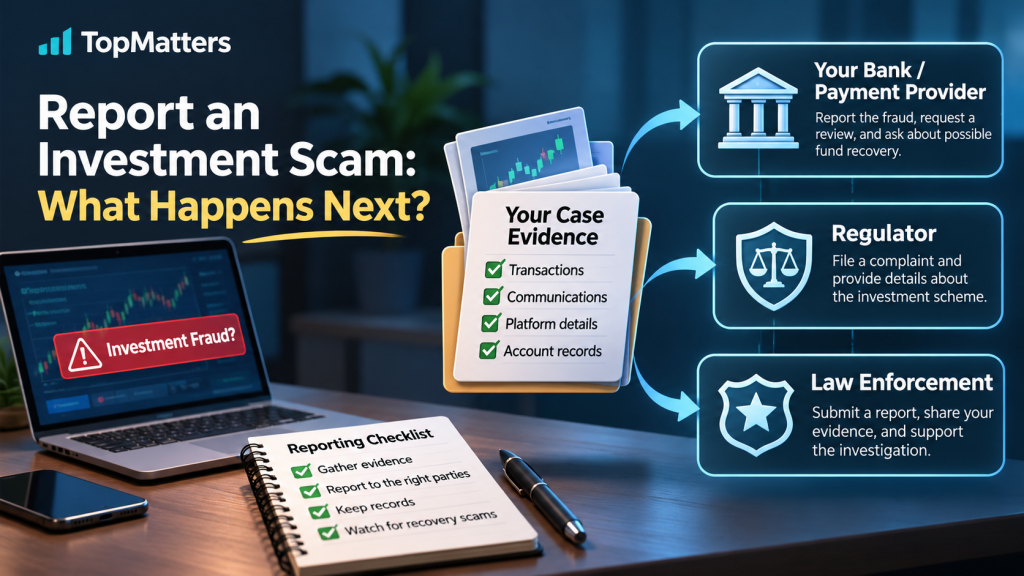
Reporting suspected investment fraud can feel like a major turning point, particularly after discovering that money may have been sent to a questionable platform. But submitting a report is usually the beginning of a process rather than the end of one. What happens next depends on how the payment was made, where the recipient is located, which authorities receive the information and how quickly action is taken. Understanding what to expect after you report an investment scam can help you preserve useful evidence, communicate effectively with relevant organisations and avoid unrealistic expectations. If you need help organising the information surrounding a disputed investment, you can also Submit Your Case to TopMatters for an initial assessment.
Start With the Organisation That Sent the Money
One of the first contacts should generally be the bank, card issuer, cryptocurrency exchange or payment provider used to make the transfer.
Explain that you believe the payment may be connected to investment fraud and provide accurate transaction information.
For bank transfers, this may include the beneficiary name, account number, payment reference, amount and date. Card payments require the relevant transaction details, while cryptocurrency transfers should be documented with wallet addresses and transaction hashes.
The provider may investigate the payment or explain what options remain available. The possible response varies considerably depending on the payment method, jurisdiction and circumstances.
Speed can matter, but contacting a payment provider does not guarantee that funds can be recalled or frozen.
Preserve Evidence Before It Disappears
Reporting becomes much easier when the supporting evidence is organised.
Save screenshots of account balances, withdrawal requests and important statements made by the investment platform. Keep emails, text messages, social-media conversations and messaging-app chats.
You should also retain copies of identification documents or agreements you submitted, together with payment instructions and receipts.
Our guide on how to preserve evidence after cryptocurrency fraud explains why records should be collected before websites, accounts or conversations become inaccessible.
Avoid editing original screenshots or transaction records. Keeping original copies can help preserve dates, account names and other details that may later become relevant.
What Happens After You Report an Investment Scam to a Regulator?
Financial regulators collect information for purposes that can include market supervision, consumer protection and enforcement.
A report may help a regulator identify patterns involving a particular firm, website, telephone number or investment promotion. If sufficient concerns exist, a regulator may investigate or publish a consumer warning.
However, submitting a report to a regulator should not automatically be interpreted as opening a personal recovery case.
A regulator’s responsibilities are different from those of your bank, police or private legal representative. Its ability to obtain compensation for an individual complainant also depends on its powers and the circumstances involved.
This is why reporting to the appropriate organisations can involve more than one channel.
A Report Does Not Automatically Freeze the Money
This distinction is especially important.
People sometimes assume that once fraud has been reported, the recipient’s account or cryptocurrency wallet will immediately be frozen. In practice, the process is more complicated.
Banks and exchanges operate under legal, compliance and jurisdictional requirements. Law-enforcement agencies may need to obtain information or legal authority before certain actions can be taken.
Cryptocurrency creates additional complications because assets can move rapidly between wallets, exchanges, bridges and other services.
Blockchain analysis may help establish where cryptocurrency travelled. But tracing and recovery are not the same thing. Identifying a transaction path does not itself provide authority to seize assets from a wallet or exchange.
What Law Enforcement May Need From You
If the matter is reported to law enforcement, investigators may need a clear chronology.
Prepare a straightforward timeline showing when contact began, how the investment was presented, when payments occurred and when problems first appeared.
Include identifying information used by the people involved: names, email addresses, telephone numbers, website domains, social-media profiles and wallet addresses.
Transaction evidence is particularly valuable.
Instead of sending hundreds of unsorted screenshots, create an organised record that allows another person to understand what happened without reconstructing the entire case from scratch.
Our guide on how to prepare a digital asset case explains how this information can be organised more effectively.
Be Prepared for Follow-Up Questions
After reporting, you may receive requests for clarification or additional documentation.
Keep the reference numbers associated with your reports and record which organisation you contacted, when you contacted it and what information you supplied.
If you discover additional transactions or new communications later, retain those records as well.
Avoid exaggerating details in an attempt to make the case appear more urgent. Accurate amounts, dates and communications are more useful than assumptions about where the money ultimately went.
Be Careful Who Contacts You Afterwards
Reporting investment fraud can sometimes be followed by an entirely different risk: recovery scams.
Someone may contact you claiming to be an investigator, blockchain expert, government representative or recovery specialist who has supposedly located your funds.
Be especially cautious if the person guarantees recovery or demands an upfront cryptocurrency payment before supposedly releasing money.
Fraud victims can be targeted again because they have already demonstrated that they are actively trying to recover a financial loss. Our guide to crypto recovery scams explains several warning signs associated with this secondary form of targeting.
Verify organisations independently before sending money or providing additional sensitive information.
Reporting Is Important, but Expectations Should Remain Realistic
When you report an investment scam, you create a documented record that may assist payment providers, regulators or law-enforcement agencies. Reporting can also help authorities identify patterns affecting other investors.
But a report should not be confused with a guarantee of reimbursement.
The movement of funds, the recipient’s location, payment method, available evidence and applicable legal powers can all affect what happens next.
The most useful approach is therefore practical: report promptly, preserve evidence, contact the organisations involved in the payment, maintain an accurate case timeline and remain cautious about anyone promising an immediate solution.
A well-documented report cannot guarantee recovery, but it can give the organisations examining the matter clearer information with which to work.