
Recovery promises: the warning signs to recognise
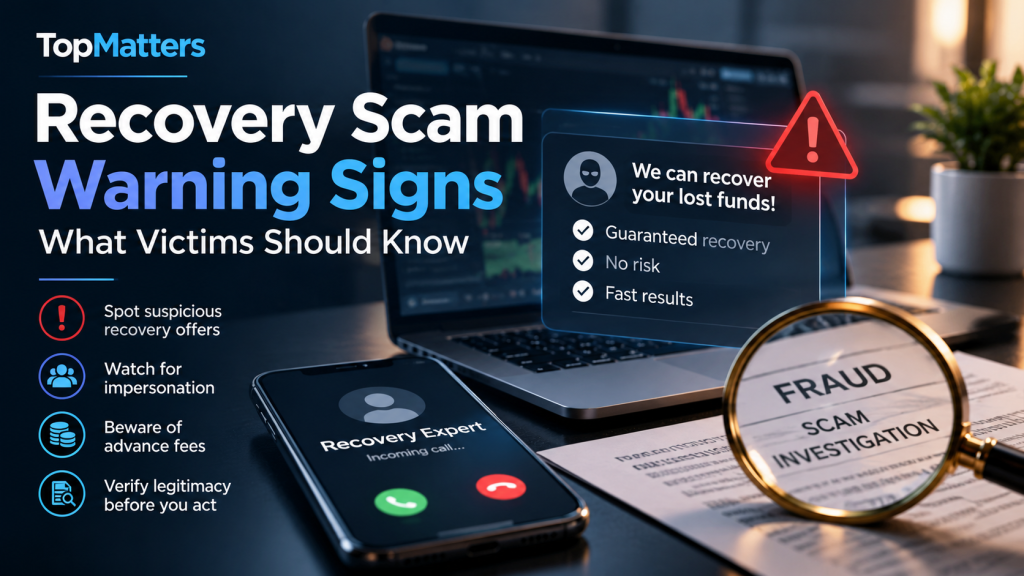
At TopMatters, recovery and financial investigation work begins with examining available evidence rather than making guarantees about outcomes. People who have already lost money to investment fraud, cryptocurrency scams, or other financial schemes can become targets of secondary scams, making it important to understand the recovery scam warning signs that distinguish evidence-based assistance from unrealistic or misleading promises.
A responsible recovery or investigation service should assess the circumstances of each case individually. Transaction records, wallet addresses, communications, payment history, and other available evidence may need to be reviewed before determining what options may be available. No recovery provider can responsibly guarantee that lost money or cryptocurrency will be returned before the relevant facts have been examined.
Watch for Guaranteed Recovery Promises
One of the most important recovery scam warning signs is certainty where uncertainty should exist.
Statements such as “your funds have already been located,” “100% recovery guaranteed,” or “your money will be returned within 24 hours” should be treated cautiously when no meaningful investigation has taken place.
Digital asset cases can involve multiple wallets, exchanges, intermediaries, jurisdictions, and payment methods. Blockchain transactions may provide useful evidence, but identifying the movement of cryptocurrency does not automatically mean that the assets can be seized or returned.
A credible assessment should distinguish between what can be verified and what remains uncertain.
Be Cautious About Unexpected Recovery Contact
Fraud victims may sometimes receive unsolicited emails, telephone calls, social media messages, or direct messages from people claiming to know about their previous loss.
Ask an important question: How did this person obtain information about the case?
Someone claiming to represent a government agency, law firm, blockchain investigator, exchange, or recovery company should be independently verified. Do not rely exclusively on telephone numbers, email addresses, websites, identification documents, or links supplied by the person contacting you.
Impersonation can make fraudulent approaches appear convincing.
Advance Fees Deserve Careful Scrutiny
A request for payment does not by itself establish that a service is fraudulent. Professional investigators, lawyers, forensic specialists, and other legitimate service providers may charge fees for their work.
The concern is the explanation behind the payment.
Be especially cautious when someone claims that money must be paid to “unlock” recovered funds, satisfy a cryptocurrency tax, activate a wallet, obtain a clearance certificate, or release assets supposedly being held on your behalf.
If additional payments continue appearing whenever the victim expects funds to be returned, stop and reassess the situation.
Understand the Limits of Private Recovery Services
Private organisations have limits.
A blockchain investigation may trace transactions, identify relevant wallet addresses, document transaction paths, and potentially establish connections to known services or exchanges. However, tracing cryptocurrency is not the same as controlling the destination wallet.
A private company generally cannot simply issue a seizure order, compel an exchange to surrender assets, or exercise powers reserved for courts and government authorities.
This distinction is important when evaluating recovery claims.
For a more detailed explanation of the investigative process, see TopMatters’ Digital Asset Recovery: What It Is, How It Works, and What Victims Should Know guide.
Never Share Private Keys or Seed Phrases
Requests for sensitive wallet credentials are another serious warning sign.
Your wallet’s seed phrase or private key can provide control over your cryptocurrency. Someone who obtains those credentials may be able to transfer the assets.
A person claiming that your seed phrase is required to “investigate,” “verify,” “synchronize,” or “recover” cryptocurrency should be treated with extreme caution.
Transaction hashes and public wallet addresses can be useful for blockchain analysis. They are fundamentally different from credentials that provide control over a wallet.
Pressure Tactics Are a Warning Sign
Recovery decisions should not be made under artificial pressure.
Be cautious of statements such as:
- “You must pay today or the funds will disappear.”
- “The wallet will be permanently frozen within hours.”
- “Do not contact your bank or law enforcement.”
- “You cannot discuss this case with anyone.”
- “This is your final opportunity to recover the money.”
Pressure can discourage independent verification. A legitimate investigation should allow reasonable questions about the process, evidence, fees, limitations, and identity of the organisation involved.
Use Official Reporting Routes
Victims should preserve records of what happened, including transaction hashes, wallet addresses, bank records, emails, messages, screenshots, platform account information, and payment receipts.
Suspected fraud can also be reported through appropriate official channels. In the United States, the FBI’s Internet Crime Complaint Center (IC3) accepts reports concerning internet-enabled crime, while the Federal Trade Commission (FTC) provides information and reporting resources for fraud.
Official reporting does not guarantee recovery, but it can create an important record of the incident.
Recovery Scam Warning Signs: How to Evaluate a Recovery Offer
Recognising recovery scam warning signs ultimately comes down to verification.
Before sending money or sensitive information, determine who you are dealing with. Ask what evidence supports their conclusions, what work will actually be performed, what limitations apply, and what fees are involved.
Be especially careful when the proposed solution depends on secrecy, urgency, guaranteed results, repeated unexpected payments, or access to sensitive wallet credentials.
Recovery should be approached as an evidence-based process rather than a promise.
At TopMatters, recovery and digital asset investigations are approached as evidence-based processes rather than guaranteed outcomes. Each matter may involve reviewing transaction records, payment information, wallet activity, communications, and other available evidence to establish the facts, preserve relevant information, and assess realistic recovery options. No legitimate assessment should begin with the assumption that every financial or digital asset loss can be recovered.
Individuals who have experienced significant financial or cryptocurrency losses can submit a case for an initial assessment. Providing relevant information about the transaction or investment can help determine what investigative steps may be appropriate while avoiding unrealistic promises about the eventual outcome.