
Tracing and recovery: understand the difference
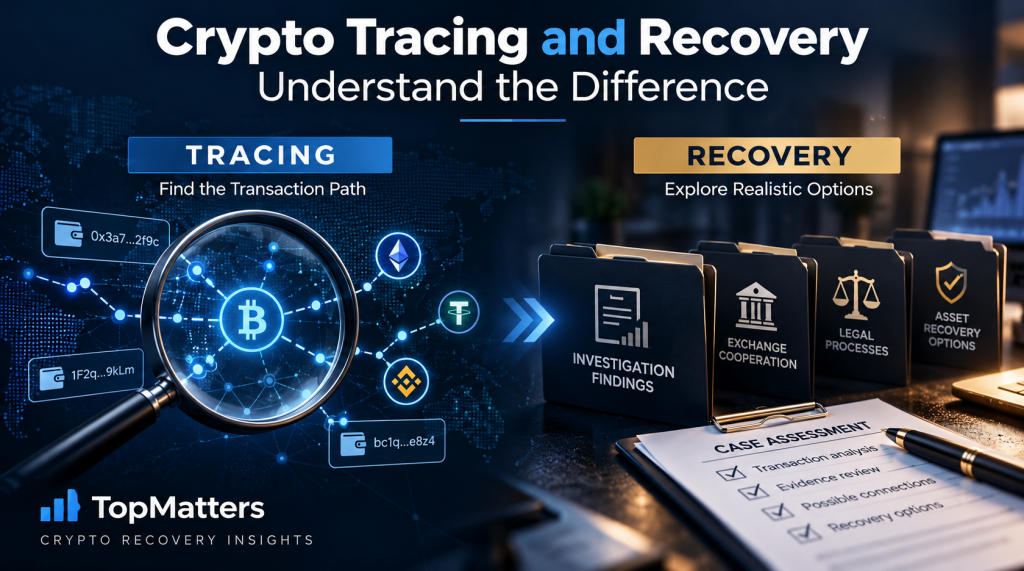
When cryptocurrency is lost through fraud, the words “tracing” and “recovery” are often used as though they describe the same process. They do not. Understanding the difference between crypto tracing and recovery is important because identifying where digital assets moved does not automatically mean those assets can be returned.
Blockchain analysis can provide valuable evidence about transactions and wallet activity. Recovery, however, may depend on additional factors such as who controls the destination wallet, whether an exchange or other service provider is involved, the available evidence, and what legal or regulatory options exist.
Crypto Tracing and Recovery Are Different Processes
Cryptocurrency tracing is primarily an investigative process.
Public blockchains record transactions that can often be reviewed after they occur. Investigators may examine transaction hashes, wallet addresses, timestamps, transferred amounts, and the movement of assets between addresses.
This can help establish a transaction path.
Recovery concerns what happens after useful information has been identified. Returning assets may require cooperation from a cryptocurrency exchange, legal action, law-enforcement involvement, account restrictions, or other procedures depending on the circumstances.
A transaction trail is therefore evidence—not a guarantee of recovery.
What Cryptocurrency Tracing Can Reveal
Blockchain tracing may help investigators understand how cryptocurrency moved after leaving a victim’s wallet or exchange account.
For example, analysis may identify:
- Wallet addresses that received the assets
- Subsequent transfers between addresses
- The blockchain networks involved
- Transaction dates and amounts
- Connections to identifiable cryptocurrency services
- Patterns that may be relevant to the investigation
This information can help create a clearer picture of what happened.
However, blockchain records generally identify wallet addresses rather than automatically revealing the real-world identity of the person controlling them.
Why Identifying a Wallet Is Not the Same as Controlling It
One of the most important distinctions in crypto tracing and recovery is the difference between locating transaction activity and gaining control over assets.
An investigator may be able to establish that cryptocurrency reached a particular wallet. That does not give the investigator access to that wallet.
Private keys and seed phrases determine control of self-custodied cryptocurrency wallets. A legitimate blockchain investigation does not magically provide those credentials.
This is also why claims that an investigator can simply “hack” a destination wallet and return cryptocurrency should be treated cautiously.
When an Exchange Appears in the Transaction Trail
A transaction path may sometimes lead to an address associated with a cryptocurrency exchange or another identifiable service provider.
That can be significant because centralized services may maintain customer records beyond what is visible on a public blockchain.
However, identifying a possible exchange connection still does not mean the exchange will automatically return funds.
Information requests, account restrictions, disclosure of customer information, or asset seizures can involve specific legal and compliance procedures. Requirements can vary depending on the service provider, jurisdiction, evidence, and circumstances of the case.
Why Recovery Cannot Be Guaranteed
No responsible investigator should treat tracing results as a guaranteed recovery outcome.
Assets may have been transferred repeatedly, moved across different blockchain networks, exchanged for other assets, sent through services that complicate attribution, or transferred into wallets whose controllers cannot readily be identified.
Even when investigators establish a useful transaction path, practical and legal obstacles may remain.
For that reason, crypto tracing and recovery should be approached as related but separate stages: first establish what the available evidence shows, then assess what realistic options may follow.
Evidence Matters at the Beginning
The quality of an investigation often depends on the records available.
Victims should preserve transaction hashes, public wallet addresses, exchange records, payment receipts, emails, messages, website addresses, screenshots, and a timeline of events.
Do not provide seed phrases, private keys, passwords, or authentication codes as part of ordinary case evidence.
TopMatters’ Before you submit a case: organise the facts guide explains how to prepare transaction records and supporting information before requesting an assessment.
Tracing Should Lead to an Evidence-Based Assessment
A useful tracing report should explain what was reviewed, what transaction activity was observed, and where uncertainty remains.
It should distinguish verified blockchain activity from assumptions about identity or ownership.
For example, saying that cryptocurrency was transferred to a specific address is different from claiming that a particular individual controls that address. Attribution should be supported by evidence rather than presented as certainty without verification.
TopMatters’ Digital Asset Recovery: What It Is, How It Works, and What Victims Should Know guide provides a broader explanation of how tracing, investigation, and recovery assessment can work together.
Questions to Ask Before Engaging a Recovery Service
Before paying for tracing or recovery assistance, ask what work will actually be performed.
Find out whether the proposed service involves blockchain analysis, evidence review, investigative reporting, legal support, or another process. Ask what information is required, what limitations apply, and what deliverables you should expect.
Be cautious when someone promises guaranteed recovery before reviewing the evidence or claims that additional cryptocurrency must be sent to “unlock” or “release” funds.
A professional assessment should set realistic expectations rather than create certainty where none exists.
Understanding the Difference Protects Victims
The distinction between crypto tracing and recovery matters because victims need accurate information about what an investigation can—and cannot—accomplish.
Tracing can help establish transaction paths, identify relevant wallet activity, and develop evidence. Recovery is a separate outcome that depends on what the investigation reveals and what options are actually available afterward.
At TopMatters, the starting point is evidence: understand the transaction history, document what can be verified, identify relevant connections, and assess realistic next steps.
If you have transaction records relating to a suspected cryptocurrency fraud or digital asset loss, you can submit your case for an initial assessment so the available evidence can be reviewed.