
Investment Fraud Investigations: Warning Signs, Evidence, and Next Steps
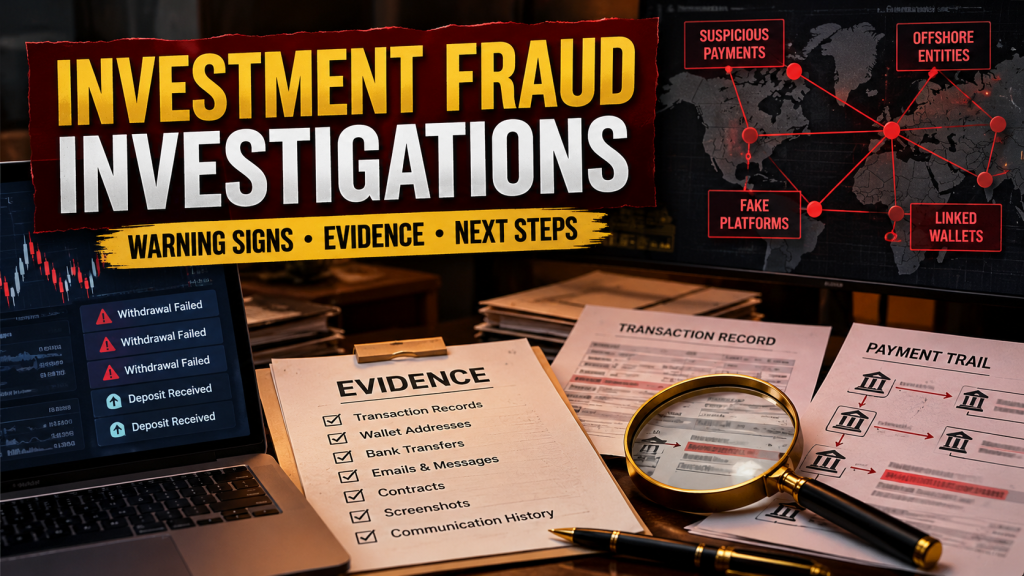
Investment fraud rarely begins with something that obviously looks fraudulent. It may start with a professional website, an unexpected message, an online advertisement, or a conversation with someone who appears knowledgeable about financial markets.
The problem often becomes visible later: withdrawals fail, additional payments are demanded, account balances become questionable, or the supposed investment representative suddenly stops responding.
At that point, investment fraud investigations should focus less on what the platform claimed and more on what the available evidence can establish.
Investigation Brief: The First Questions That Matter
When suspicious activity is discovered, investigators need to reconstruct the events surrounding the investment.
Three questions usually provide a useful starting point:
Who received the money?
Bank details, cryptocurrency wallet addresses, payment processors, beneficiary information, and transaction records may help establish where funds were actually sent.
How was the investment presented?
Websites, emails, advertisements, messaging applications, account dashboards, contracts, and conversations may reveal what representations were made.
What happened when withdrawal was requested?
Repeated delays, changing explanations, unexpected charges, or demands for additional deposits can become important parts of the evidence.
These questions shift attention away from promises and toward verifiable facts.
Warning Signs That Deserve Closer Examination
No single warning sign automatically proves investment fraud. Legitimate businesses can experience delays, technical problems, or customer-service disputes.
Concern increases when several questionable behaviors appear together.
Examples may include guaranteed or unusually consistent returns, pressure to invest quickly, unsolicited approaches from supposed advisers, unclear company information, or requests to send funds to unrelated accounts.
Withdrawal behavior can be particularly revealing.
A person may be told that a tax, commission, insurance payment, verification deposit, liquidity charge, or account upgrade must be paid before existing funds can be released.
The terminology can sound official. What matters is whether the demand can be independently verified.
An investigation should document these requests rather than assuming that professional language makes them legitimate.
Evidence File: What Should Be Preserved?
A useful investigation file should allow another person to understand what happened without relying entirely on memory.
That means preserving original records wherever possible.
Important material can include:
- Bank transfer confirmations
- Cryptocurrency transaction hashes
- Wallet addresses
- Exchange withdrawal records
- Emails and message histories
- Screenshots of account balances
- Website addresses
- Names and telephone numbers used by representatives
- Contracts or investment documents
- Receipts and payment instructions
Dates matter as well.
A simple chronological record showing when contact began, when payments were made, when withdrawals were attempted, and when additional demands appeared can reveal patterns that individual screenshots do not.
Victims should also avoid deleting communications simply because they are embarrassing, repetitive, or apparently unimportant. A small detail may later help connect two parts of the investigation.
Follow the Payment, Not the Dashboard
A displayed investment balance is not necessarily proof that corresponding assets exist.
This distinction is especially important with questionable online investment platforms.
A website may show profits, trading activity, account levels, or rapidly increasing balances. Those figures should be treated separately from independently verifiable financial records.
Investigators instead examine the actual movement of money.
For a bank transfer, that may involve beneficiary information and transaction documentation.
For cryptocurrency, it may involve reviewing the blockchain transaction, destination address, and subsequent movement of the digital assets.
The central question is not simply, “What did the account say the investment was worth?”
It is: “What happened to the money that was actually sent?”
When the Evidence Points Beyond One Platform
Investment fraud investigations can sometimes reveal connections that are not obvious at the beginning.
The same wallet address may appear in multiple transactions. A payment beneficiary may differ from the company name shown on a website. Several domains may use similar contact details, documents, or payment instructions.
These connections require careful interpretation.
Shared infrastructure or transaction activity does not automatically prove that two businesses are operated by the same people. Investigators should distinguish between what is confirmed, what is strongly indicated, and what remains unknown.
That distinction protects the integrity of the investigation.
What to Do When You Suspect Investment Fraud
Continuing to send money simply because previous funds are already at risk can make the situation worse.
If serious concerns arise, preserve the evidence before making major changes to accounts or communications. Record transaction details, save relevant correspondence, and document the website or platform involved.
If cryptocurrency was used, preserve the transaction hash and destination wallet address rather than relying only on screenshots.
Consider contacting the financial institution or cryptocurrency exchange used to send the funds. Depending on the circumstances and timing, they may have procedures for reporting suspected fraud.
Appropriate reports to law enforcement or financial regulators may also create an official record of the incident.
Most importantly, be cautious if a new person contacts you claiming that the lost investment has already been located or recovered. Victims of one financial fraud can become targets for a second scheme built around promises of recovery.
What an Investigation Can Realistically Establish
A responsible investigation cannot begin by promising a particular outcome.
Its first purpose is to establish facts.
That may mean identifying payment destinations, reconstructing cryptocurrency movements, examining communications, researching entities connected with the transaction, or determining whether funds interacted with identifiable financial services.
Some investigations produce strong leads. Others encounter significant limitations.
Both outcomes are valuable if they replace assumptions with evidence.
At TopMatters, the purpose of an initial investigation is not to manufacture certainty where none exists. It is to determine what the records show, where important information is missing, and which next steps are supported by the available evidence.
For victims facing a suspected investment fraud, that distinction matters: before deciding what can be recovered, first establish what actually happened.