
Why Evidence Preservation Matters in Digital Asset Recovery Cases
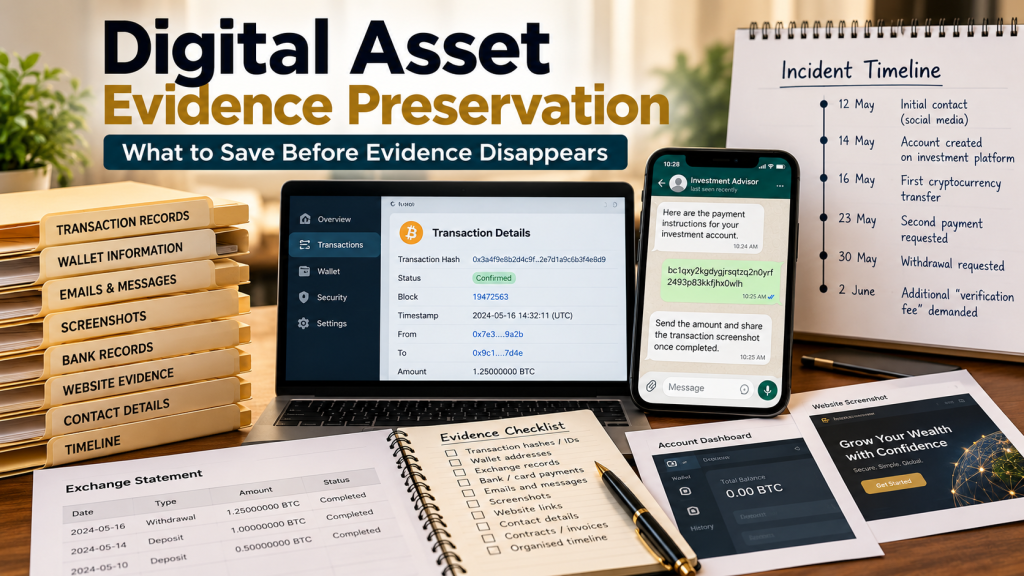
After discovering a cryptocurrency theft or suspected investment fraud, the first instinct may be to focus entirely on getting the money back. But before any meaningful investigation can begin, there is another priority: preserving the evidence.
Digital asset evidence preservation means keeping the transaction records, communications, wallet information, screenshots, and other material that may help establish what happened.
A blockchain transaction can remain visible, but much of the surrounding evidence can disappear. Websites can go offline. Messages can be deleted. Account access can be restricted. Online profiles can change.
Preserving evidence early can therefore make a significant difference to what can later be verified.
The Evidence Exists in More Than One Place
A digital asset case rarely depends on a single screenshot or transaction hash.
The useful evidence may be spread across several places: a cryptocurrency exchange account, emails, messaging applications, bank records, browser history, a fraudulent website, and the blockchain itself.
Consider someone who purchased cryptocurrency through an exchange and then transferred it to a supposed investment platform.
The blockchain may show the transfer, but it does not explain why the payment was made.
Messages may contain the payment instructions. The exchange account may document the withdrawal. The website may show how the investment was represented. Emails may identify names or contact details used during the interaction.
Together, those records provide context.
Digital Asset Evidence Preservation: What Should You Keep?
If you suspect digital asset fraud, begin by creating an organised record of the incident.
Where available, preserve:
- Transaction hashes or transaction IDs
- Sending and receiving wallet addresses
- Cryptocurrency amounts
- Dates and approximate times
- Exchange deposit and withdrawal records
- Bank or card payment records
- Emails and message histories
- Screenshots of account dashboards
- Website addresses and profile links
- Names, usernames, telephone numbers, and email addresses used by contacts
- Contracts, invoices, receipts, or payment instructions
Do not worry about deciding immediately which item is important.
During an investigation, information that initially appears insignificant may help confirm a date, connect a transaction, or explain why a particular payment occurred.
Screenshots Are Useful—but Keep the Original Records Too
Screenshots can preserve information that might later disappear, particularly website pages, account dashboards, advertisements, and messages.
But screenshots should not be the only evidence retained.
Whenever possible, keep the underlying record as well.
For example, if you have a cryptocurrency transaction, preserve the actual transaction hash rather than only taking a screenshot of the transfer. If an exchange provides downloadable transaction history, keep a copy. If important information arrived by email, retain the original email rather than relying exclusively on a cropped image.
Original records can contain details that screenshots leave out.
Build a Simple Timeline
One of the most useful things a victim can create is also one of the simplest: a chronological timeline.
It does not need to be complicated.
Record when contact began, when an account was created, when each payment was made, when withdrawal problems started, and when additional payments were requested.
For example:
12 May — Initial contact through social media
14 May — Account created on investment website
16 May — First cryptocurrency transfer
23 May — Second payment requested
30 May — Withdrawal requested
2 June — Additional “verification fee” demanded
A timeline helps turn disconnected records into a sequence that can be examined.
It can also reduce confusion later, particularly when an incident involved weeks or months of communication.
Avoid Altering Evidence Unnecessarily
Preserving evidence also means avoiding unnecessary changes to the original material.
Do not edit screenshots in ways that remove useful context. Avoid deleting message threads after saving only a few selected messages. Keep original filenames and documents where practical.
If you need to annotate something for your own notes, consider keeping the original version separately.
The goal is straightforward: preserve what you received or observed as accurately as possible.
Evidence Can Disappear Quickly
Some digital evidence is more temporary than people realize.
A website can be removed. A social-media account can disappear. A messaging profile can change its name or photograph. Access to an online investment dashboard may suddenly stop working.
If a platform becomes suspicious, documenting what is currently visible may therefore be useful.
That does not mean repeatedly logging into an account if doing so creates security concerns. It means preserving relevant information that you already have legitimate access to before it becomes unavailable.
A Quick Evidence-Preservation Check
Before considering the evidence file complete, ask:
Can I show where the money came from?
Can I show where it was sent?
Can I identify the transaction involved?
Can I show what I was told before making the payment?
Can I document what happened when I tried to withdraw or recover the funds?
Can another person understand the sequence without relying entirely on my memory?
If several answers are no, there may still be important records to locate.
Preservation Comes Before Conclusions
Evidence preservation does not prove that fraud occurred, identify the person responsible, or guarantee that digital assets can be recovered.
Its purpose is more fundamental.
It protects the information needed to investigate those questions properly.
At TopMatters, digital asset cases are approached by establishing what can be independently verified before drawing conclusions about transaction paths, entities, or possible recovery options.
A well-organised evidence file provides a stronger starting point for that process.
When digital assets are lost or suspected fraud is discovered, acting quickly matters—but preserving the right information can be just as important as deciding what to do next.