
How Blockchain Transaction Tracing Works After Cryptocurrency Fraud
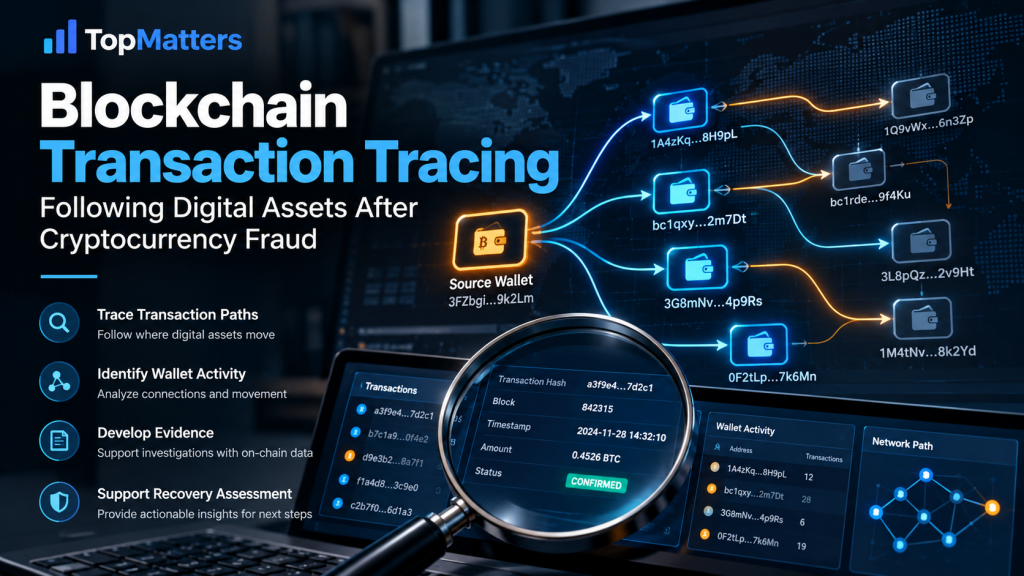
When cryptocurrency is transferred as part of a suspected fraud, the transaction may feel final. Unlike a traditional bank transfer, there may be no simple cancellation process or central institution capable of reversing the payment. However, that does not necessarily mean the transaction disappears without a record.
Public blockchain networks preserve transaction data that can be examined after funds have moved. Blockchain transaction tracing uses this information to reconstruct transaction paths, identify relevant wallet activity, and develop evidence that may help investigators understand where digital assets went.
Tracing is not the same as recovering cryptocurrency. Instead, it is an investigative process designed to establish what can be verified from the available blockchain and supporting evidence.
What Is Blockchain Transaction Tracing?
Blockchain transaction tracing is the process of examining cryptocurrency transactions recorded on blockchain networks and following the movement of digital assets between addresses.
Depending on the blockchain, investigators may review information such as:
- Transaction hashes or transaction IDs
- Sending and receiving wallet addresses
- Cryptocurrency amounts
- Transaction dates and timestamps
- Subsequent transfers from receiving addresses
- Interactions with exchanges or other cryptocurrency services
- Movement between different digital assets or networks
Individual transactions can then be examined as part of a larger transaction history.
Rather than looking at one transfer in isolation, investigators attempt to understand the sequence of events surrounding the movement of the assets.
The Investigation Starts With the Original Transaction
A useful trace usually begins with a confirmed starting point.
Suppose someone sent cryptocurrency to a wallet address provided by what they later suspected was a fraudulent investment platform. The transaction hash can provide a verifiable reference for the transfer.
From that starting point, an investigator can examine the destination address and determine whether the cryptocurrency subsequently moved elsewhere.
The process may reveal additional wallet addresses and transactions that form a longer movement path.
This is why transaction records are so important. Screenshots of an account balance may provide context, but blockchain transaction information can independently establish that a particular on-chain transfer occurred.
Following the Transaction Path
Cryptocurrency does not necessarily remain at the first receiving address.
Assets can be moved through several addresses, divided into smaller amounts, combined with other funds, exchanged for different digital assets, or transferred through services operating across multiple blockchain networks.
Blockchain transaction tracing attempts to follow these movements systematically.
Specialist blockchain-analysis tools can represent transactions visually as graphs. Addresses and identifiable services may appear as connected points, allowing an analyst to examine how value moved through a network of transactions.
The resulting transaction path can help answer questions such as:
Where did the cryptocurrency move after the original payment?
Was it transferred again?
Did the assets interact with a known cryptocurrency service?
Were funds divided among multiple addresses?
Did the transaction path continue onto another blockchain?
The answers can help determine what investigative steps may be worth considering next.
Wallet Addresses Do Not Automatically Reveal Identity
One of the most important limitations of blockchain investigation is that a wallet address is not the same thing as a person’s name.
Public blockchain records can show that cryptocurrency moved from one address to another, but they do not automatically identify the individual controlling every address.
Investigators therefore need to distinguish between transaction evidence and identity attribution.
A transaction may establish that assets reached a particular address. Connecting that address to a specific exchange, service, organization, or individual requires additional evidence.
This distinction helps prevent assumptions from being presented as verified findings.
Wallet Clustering and Attribution
Blockchain analysis can sometimes identify relationships between multiple addresses.
Certain analytical methods may indicate that addresses are associated with the same wallet infrastructure or entity. This process is commonly described as address or wallet clustering.
Attribution goes further.
It attempts to connect blockchain activity with a real-world entity, such as a cryptocurrency exchange or another identifiable service.
Reliable attribution can involve a combination of blockchain analysis and information from outside the blockchain. The strength of any attribution should therefore depend on the evidence supporting it rather than simply on the appearance of a transaction graph.
Investigators should be clear about the difference between what the blockchain proves and what additional intelligence suggests.
What Happens When Funds Reach an Exchange?
A particularly important development can occur when a transaction path reaches an identifiable centralized cryptocurrency service.
Centralized exchanges may maintain information that does not appear publicly on the blockchain, potentially including customer-account and compliance records.
However, identifying an exchange-associated address does not mean an investigator can simply request the cryptocurrency back.
Disclosure of customer information, account restrictions, freezing of assets, or other actions may require appropriate legal, compliance, or law-enforcement procedures. Requirements can also vary between jurisdictions and service providers.
This is one reason tracing should be viewed as an evidence-development process rather than a promise of recovery.
Cross-Chain Transactions Can Make Tracing More Complex
Modern cryptocurrency activity does not always remain on a single blockchain.
Assets may move through bridges, decentralized exchanges, token swaps, or other mechanisms that change the asset or blockchain being used.
For example, an investigation that begins with one cryptocurrency may eventually require analysis of transactions involving several different tokens and networks.
These movements can make an investigation more complex because the analyst must correctly establish the relationship between transactions occurring in different environments.
Complexity, however, should not be confused with impossibility. The question is whether enough reliable evidence exists to continue reconstructing the movement of value.
Why Evidence Preservation Matters
Blockchain records are only one part of a cryptocurrency fraud investigation.
Victims should also preserve supporting information such as:
- Exchange transaction records
- Wallet addresses
- Transaction hashes
- Emails and messages
- Website addresses
- Payment instructions
- Screenshots
- Names or identifiers used by the other party
- A chronological timeline of events
TopMatters’ Before you submit a case: organise the facts guide explains how to prepare these records before requesting an assessment.
Never provide a recovery service with your seed phrase, private keys, passwords, or authentication codes as ordinary evidence.
Tracing Does Not Guarantee Recovery
This distinction is essential.
An investigator may successfully trace cryptocurrency through several transactions and identify where the assets eventually moved. That result does not automatically provide control over the destination wallet or create the legal authority required to seize or return funds.
Recovery possibilities depend on what the investigation reveals.
Factors may include whether identifiable services are involved, whether assets remain accessible, the jurisdictions concerned, the quality of the evidence, and what legal or law-enforcement options are available.
Our guide Tracing and recovery: understand the difference examines this distinction in greater detail.
What a Useful Tracing Assessment Should Provide
A professional investigation should separate confirmed findings from assumptions.
A useful assessment may identify the original transaction, document subsequent transfers, highlight relevant wallet activity, identify possible service connections, and explain where uncertainty remains.
It should not claim that every wallet owner has been identified when the available evidence does not support that conclusion.
Likewise, tracing should never be presented as a guaranteed method of retrieving cryptocurrency.
The objective is to transform scattered transaction information into an organized evidence trail that can support informed decisions about possible next steps.
From Blockchain Evidence to a Recovery Strategy
Blockchain transaction tracing can be valuable because cryptocurrency transfers leave records that may continue to provide investigative information long after the original transaction occurred.
But tracing is only one part of the wider process.
TopMatters’ Digital Asset Recovery: What It Is, How It Works, and What Victims Should Know guide explains how transaction analysis, evidence review, investigation, and recovery assessment fit together.
At TopMatters, the process begins with evidence. The objective is to establish what happened, document what can be verified, identify relevant transaction paths and connections, and assess realistic options based on the findings.
If you have wallet addresses, transaction hashes, exchange records, or other evidence relating to suspected cryptocurrency fraud, you can submit your case for an initial assessment so the available information can be reviewed.