
How to Check an Investment Platform Before Sending Money
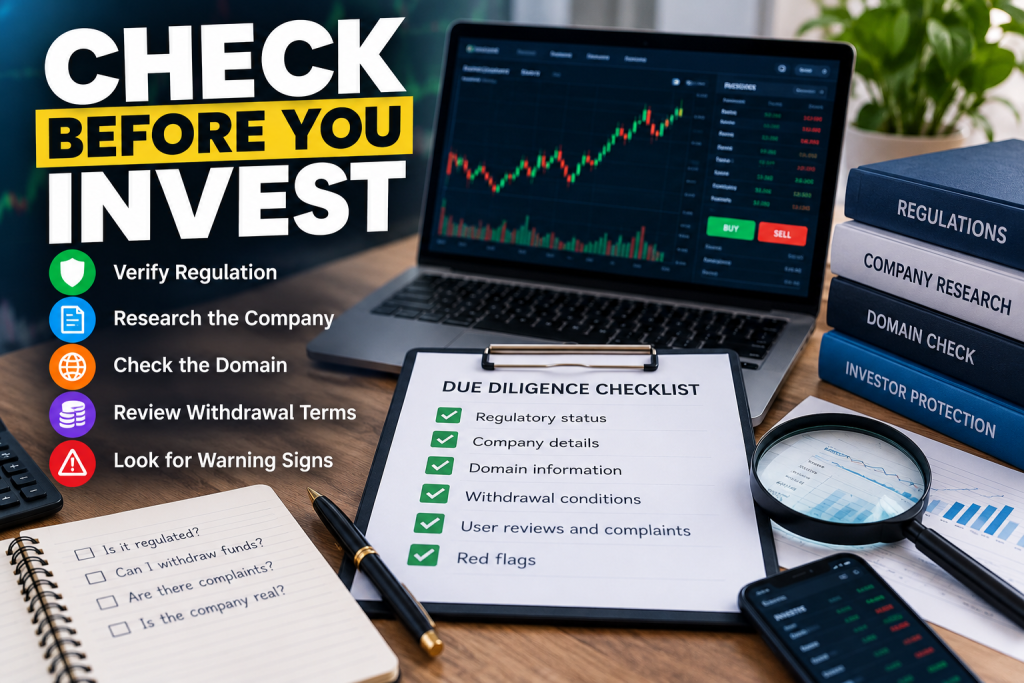
Learning how to check an investment platform before sending money can help investors identify important warning signs before funds become difficult to retrieve. A professional website, polished trading dashboard or convincing representative does not by itself establish that an investment company is legitimate. Before making a deposit, investors should independently examine the company behind the platform, its regulatory status, domain information, contact details and withdrawal conditions. If you have already transferred funds to a questionable platform and need to organise the information surrounding your case, you can Submit a Case with the relevant transaction and communication records.
Check an Investment Platform Before Sending Money: Start With Its Identity
Begin by determining exactly who operates the platform.
Look for the company’s legal name, physical address, telephone number, email address and company registration information. Do not assume that a company name displayed in a website footer proves who actually controls the website.
Search the stated company independently. Compare information from official corporate and regulatory databases with the details presented by the platform.
Pay particular attention to differences in spelling, addresses, telephone numbers and website domains. Small inconsistencies can sometimes reveal that a website is using information associated with an unrelated business.
Verify the Platform’s Regulatory Status
If a platform claims to offer regulated investments, forex, CFDs or other financial products, identify which authority supposedly regulates it.
Then check the regulator’s official database yourself.
Our guide explaining how to verify an investment platform is regulated covers this process in greater detail, including why company registration should not be confused with financial authorisation.
A legitimate company registration number does not automatically give a business permission to provide regulated investment services.
Investors should also verify what services an authorised firm is actually permitted to provide. A company authorised for one financial activity may not necessarily have permission to offer every product advertised on a website.
Search Official Warning Databases
Before transferring funds, search the platform’s name and domain through relevant financial-regulator warning databases.
Regulators such as the Financial Conduct Authority publish warnings concerning firms that may be providing or promoting financial services without appropriate permission.
Search the exact domain as well as the company name. Domains can be particularly useful because different websites may use similar company names.
Finding a regulatory warning does not eliminate the need for further research, but it is significant information that should be carefully considered before money is transferred.
Examine the Website and Domain Carefully
Look beyond the visual appearance of the website.
Check whether company information is consistent throughout the site. Review the contact page, legal documents, privacy policy, terms and conditions and any regulatory statements.
Consider whether the domain appears consistent with the company supposedly operating it.
A newly created domain does not automatically indicate wrongdoing, but it can be relevant when a website simultaneously claims many years of trading history or a long-established international presence.
Be Cautious About Extraordinary Return Claims
Investment promotions should be evaluated realistically.
Promises of unusually high returns, guaranteed profits or investment plans suggesting that substantial gains can be achieved quickly deserve additional scrutiny.
Financial markets involve risk. Legitimate investment providers generally cannot guarantee that a particular trade or strategy will produce profits.
Investors should also be cautious when representatives create urgency by claiming that a special opportunity will disappear unless money is deposited immediately.
Pressure can interfere with careful verification.
Review Withdrawal Conditions Before Depositing
Investors frequently focus on how to deposit money while paying much less attention to how withdrawals work.
Before sending funds, read the platform’s withdrawal terms. Look for information about processing times, identity verification, fees, minimum withdrawal amounts and other conditions.
Be particularly careful if important withdrawal requirements are vague or difficult to locate.
Unexpected investment withdrawal fees can become especially concerning when an investor is later told that additional taxes, commissions, insurance payments or security deposits must be paid before an existing balance can be released.
Withdrawal conditions should be understood before the initial deposit, not discovered only after a withdrawal request is submitted.
Consider How the Platform Wants You to Pay
Payment methods can provide additional information.
Record exactly where your money is being sent. If cryptocurrency is requested, preserve the destination wallet address and transaction hash. If a bank transfer is requested, record the beneficiary name, bank and account information.
Be cautious when the payment recipient appears unrelated to the company supposedly providing the investment service.
Investors should also question unexplained requests to send money to multiple individuals, companies or cryptocurrency wallets.
Preserve Information From the Beginning
Evidence preservation should begin before problems occur.
Save copies of important emails, chat messages, deposit instructions, account statements, transaction receipts and regulatory claims.
Take screenshots of important pages, particularly information concerning investment plans, withdrawal conditions and company identity.
If a dispute later develops, these records may help financial institutions, regulators, investigators or law-enforcement authorities establish what was represented and where funds were sent.
Our guide on how to preserve evidence after cryptocurrency fraud explains the types of records that can become particularly important when cryptocurrency transactions are involved.
Final Thoughts
Knowing how to check an investment platform before sending money involves more than searching the company’s name online.
Investors should verify the legal entity, check regulatory databases, compare contact details, examine the domain, evaluate return claims, understand withdrawal conditions and document payment instructions.
No single check can eliminate investment risk. However, several inconsistencies appearing together can provide important reasons to delay a deposit and investigate further.
Taking time to verify information before transferring money is considerably easier than trying to reconstruct that information after a problem has already occurred.