
Can Cryptocurrency Transactions Be Traced to a Person?
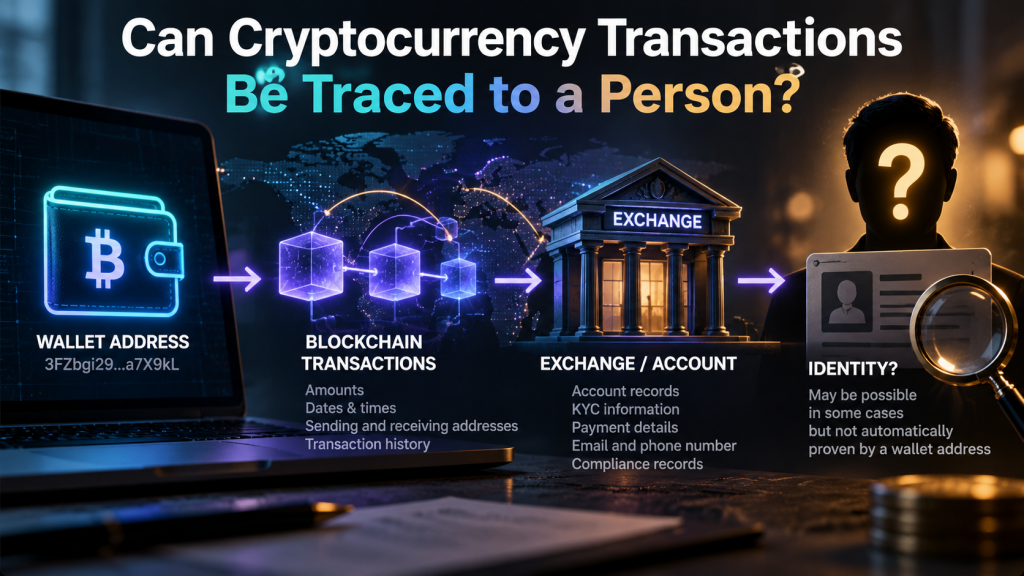
Cryptocurrency is often described as anonymous, but that description can be misleading. Transactions on many public blockchains leave permanent records that anyone with the appropriate tools can examine. The more difficult question is whether investigators can trace cryptocurrency to a person rather than simply follow funds between wallet addresses.
Sometimes, a cryptocurrency transaction trail can eventually be connected to an identifiable individual or organisation. In other cases, investigators may be able to follow the assets without establishing who actually controls the wallets involved.
Understanding that distinction is important for anyone dealing with cryptocurrency fraud, theft, or suspicious transactions.
Can Investigators Trace Cryptocurrency to a Person?
Potentially, yes—but a blockchain address does not normally display the owner’s real-world identity.
Public blockchain records may reveal where cryptocurrency was sent, when transactions occurred, how much was transferred, and where the assets moved afterward. This can create a detailed financial trail.
However, seeing a wallet address is not the same as knowing who controls it.
Connecting that address to a person usually requires additional information from outside the blockchain.
What Blockchain Records Can Reveal
Depending on the cryptocurrency and network involved, investigators may be able to examine information including:
- Sending and receiving wallet addresses
- Transaction hashes
- Transfer amounts
- Dates and times
- Subsequent transfers
- Interactions between multiple wallets
- Deposits to or withdrawals from identifiable services
Because these records can remain publicly accessible, moving cryptocurrency does not necessarily erase the transaction history.
Investigators can examine the sequence of transactions and determine whether funds have been divided among several wallets, consolidated into another address, transferred to an exchange, or moved through other blockchain services.
This is the foundation of cryptocurrency transaction tracing.
A Wallet Address Is Not a Person
This distinction is critical.
A blockchain may show that a particular wallet received cryptocurrency, but it generally does not display a name, home address, telephone number, or other conventional identifying information beside that wallet.
The wallet address is therefore a technical identifier—not automatic proof of identity.
Investigators must be careful not to assume that the person suspected of fraud necessarily controls every wallet appearing in a transaction trail.
A wallet could belong to an exchange, payment processor, intermediary, service provider, another victim, or an unrelated third party.
Attribution requires evidence.
How Cryptocurrency Can Become Connected to an Identity
The situation can change when cryptocurrency reaches a service that has information about its customers.
Centralized cryptocurrency exchanges are an important example.
Some exchanges collect customer identification information as part of their account verification and compliance procedures. Depending on the circumstances and applicable legal processes, records associated with an account may help connect blockchain activity with an identifiable customer.
Other information may also contribute to attribution, including:
- Exchange account records
- Payment information
- Email addresses
- Telephone numbers
- Login or account information
- Communications
- Website registration records
- Financial records
- Evidence collected by law enforcement
No single piece of information necessarily proves ownership. Investigators may need to combine blockchain evidence with other records before reaching a reliable conclusion.
What Happens When Stolen Cryptocurrency Moves Through Multiple Wallets?
Fraudsters may transfer cryptocurrency through several addresses after receiving it.
This can make an investigation more complicated, but multiple transfers do not automatically eliminate the transaction trail.
If the blockchain is public, investigators may still be able to follow movements from one address to another and document how the assets travelled.
The TopMatters guide Stolen Cryptocurrency Tracing: What Happens to Funds After Crypto Theft explains what investigators may observe as stolen assets move through wallets and cryptocurrency services.
The difficulty often increases when assets move across different networks, through certain privacy-enhancing services, or into environments where identifying information is limited.
Can an Exchange Identify the Owner of a Wallet?
An exchange may have information about an account holder when a wallet or deposit address is associated with its platform.
That does not mean an investigator—or a victim—can simply ask the exchange for someone’s identity and receive it.
Cryptocurrency businesses have privacy, compliance, and legal obligations. Disclosure of customer information may require appropriate legal authority, law-enforcement involvement, or another valid process depending on the circumstances and jurisdiction.
For this reason, identifying that cryptocurrency reached an exchange can be important, but it is not the same as immediately identifying the individual who ultimately controlled the funds.
Can Blockchain Tracing Reveal a Private Key?
No.
Tracing transactions does not reveal the private key or seed phrase controlling a self-custodied wallet.
A blockchain investigator may be able to identify an address and analyse its transaction history without having any ability to access the cryptocurrency stored there.
This is one reason victims should be cautious of anyone claiming that tracing a wallet automatically enables them to “hack” it or transfer the assets back.
TopMatters explains this distinction further in Tracing and Recovery: Understand the Difference.
What Evidence Helps With Attribution?
Blockchain data becomes more useful when it can be evaluated alongside reliable records from the original incident.
Useful evidence may include:
- Transaction hashes
- Destination wallet addresses
- Exchange withdrawal records
- Screenshots
- Emails and chat messages
- Website addresses
- Account details
- Payment instructions
- Dates and times
- A clear timeline of events
Preserving the original records is preferable to relying entirely on memory or reconstructed information later.
Our guide to Digital Asset Evidence Preservation explains what information should be retained when cryptocurrency fraud is suspected.
Tracing, Attribution, and Recovery Are Different Stages
These three concepts should not be treated as interchangeable.
Tracing asks where the cryptocurrency moved.
Attribution asks who may control or be associated with relevant wallets or accounts.
Recovery asks whether there is a realistic mechanism for assets to be returned.
An investigation may succeed at tracing funds without establishing identity. It may establish useful attribution without creating an immediate recovery route. And even strong evidence does not guarantee that stolen cryptocurrency will ultimately be recovered.
Keeping these stages separate helps prevent unrealistic expectations.
The Bottom Line
So, can investigators trace cryptocurrency to a person?
Sometimes—but not simply by looking at a wallet address.
Public blockchain records can provide a powerful transaction trail, while exchange records, account information, communications, financial records, and lawful investigative processes may help connect that activity to a real-world identity.
The strength of any conclusion depends on the evidence available.
At TopMatters, digital asset investigations begin by establishing what the blockchain actually shows, separating verified facts from assumptions, and identifying where additional evidence may be required.
If you have lost cryptocurrency through suspected fraud or theft, preserving the transaction records and supporting evidence is an important first step before assessing what investigative or recovery options may realistically exist.